Gripper Testing and Characterization
Why is this important?
New robotic grippers have entered the market for decades now. The designs vary in shape, size, number of fingers, and number of DoFs. Making any gripper come to life requires months of engineering work, and we want to be certain that when we add a finger or degree of freedom we know what value it is adding. What tasks is this design better at achieving? Is it worth the added complexity?
I’ve thought about this problem in many ways and have approached it from a quantitative and a qualitative approach. In the research world, there isn’t yet a standard for characterizing and baselining grippers. I took a stab at creating that for our team and communicating the results. Later on, I thought it would be more effective to have folks get a more visceral sense of gripper capabilities by hosting a workshop for folks across different disciplines on the same page for our gripper design priorities.
Gripper Testing Methodology
I designed a test methodology to compare grippers of different finger counts against each other. Originally, I wanted to be as quantitative as possible but after much thought, I realized qualitative tests are very informative as well. When I grasp something, I have an inherent sense of whether it’s a stable grasp or if after 10 seconds, the object will likely fall. I followed that thought process when designing a qualitative pick and place test centered around grasp stability. The essence of the test is that if there’s an external disturbance applied to the gripper (simulated by the data collector shaking the object), the gripper would still firmly grasp the object.
To bolster the test suite, I also designed a quantitative test centered around collecting retention force in order to complete tasks. If there’s a certain interface the robot needs to interact with (doorknob, cabinet handle, etc), I collected the max grip force the gripper could achieve prior to slipping to see if the gripper could complete that task. I designed common interface objects to mount to a 6 axis force/torque sensor to collect data. I leveraged force data collected by the team to determine force thresholds that are needed to complete a task.
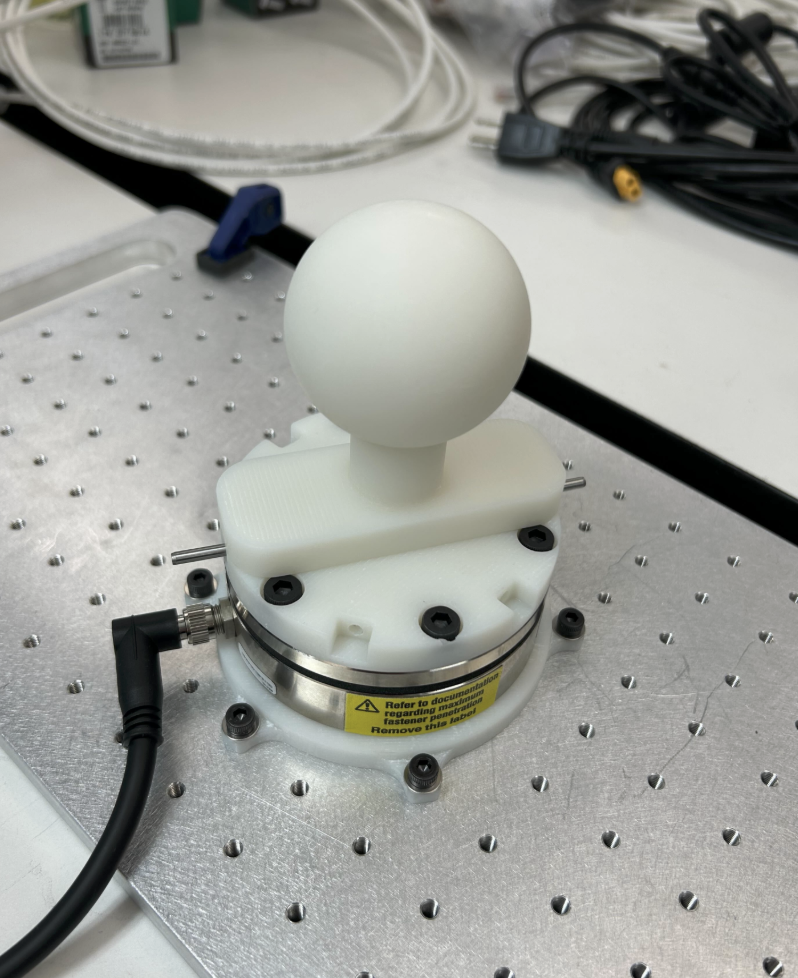
Generic doorknob shape
Mounted to an ATI Force/Torque Sensor